Specifying the wrong mixer is one of the most expensive mistakes in a powder or paste process. Choose a machine whose mixing action doesn’t match your material and you get segregation, dead zones, damaged particles, long cycle times — problems that no amount of running longer will fix. This industrial mixer buying guide walks you through the decision the way a process engineer would: start from what your material actually is, match it to a mixing action, then size and cost the machine on evidence. By the end you’ll know which mixer family fits, how big it needs to be, what really drives the price, and why you should trial your own material before you sign a purchase order.
There is no single “best” industrial mixer — only the one that suits your material state, batch size and quality target. Work through the five steps below in order and you’ll arrive at a shortlist you can defend.
Why the mixer choice matters more than the spec sheet
Every mixer imposes a mechanical action on your product. A ribbon agitator drags material axially and radially; a ploughshare flings it into a fluidized zone; sigma blades knead a stiff dough; a tumbling shell gently folds fragile granules. When that action matches the material, you get a homogeneous blend fast and undamaged. When it doesn’t, you pay for it downstream — poor content uniformity, broken crystals, overheated product, or a machine that never reaches its rated throughput. Getting the type, size and options right at specification is far cheaper than discovering the mismatch after installation. That is what the rest of this guide is built to prevent.
Step 1 — Identify your material state
Before you look at any machine, describe your material honestly. Four questions decide almost everything that follows:
- Is it dry and free-flowing? Powders and granules that pour easily (spices, premixes, fertilizer blends, plastic pellets) are the widest-compatibility case and open up the most mixer options.
- Is it fragile or cohesive? Friable granules, coated particles, or sticky cohesive powders need a gentle action that won’t shear or degrade them.
- Does it need fast, intense mixing — or a liquid addition? Adding a binder, wetting agent, or dispersing a minor liquid into a powder calls for a high-intensity action with choppers or spray bars.
- Is it a thick paste, dough or high-viscosity mass? Putties, sealants, rubber compounds and dough-like masses can’t be tumbled or ribboned — they must be kneaded.
Write down your bulk density, moisture, particle-size range, viscosity (if any), and whether the active is a minor fraction that must be distributed evenly. These numbers drive both the type match in Step 2 and the sizing math in Step 3.
Step 2 — Match the material to the mixer type
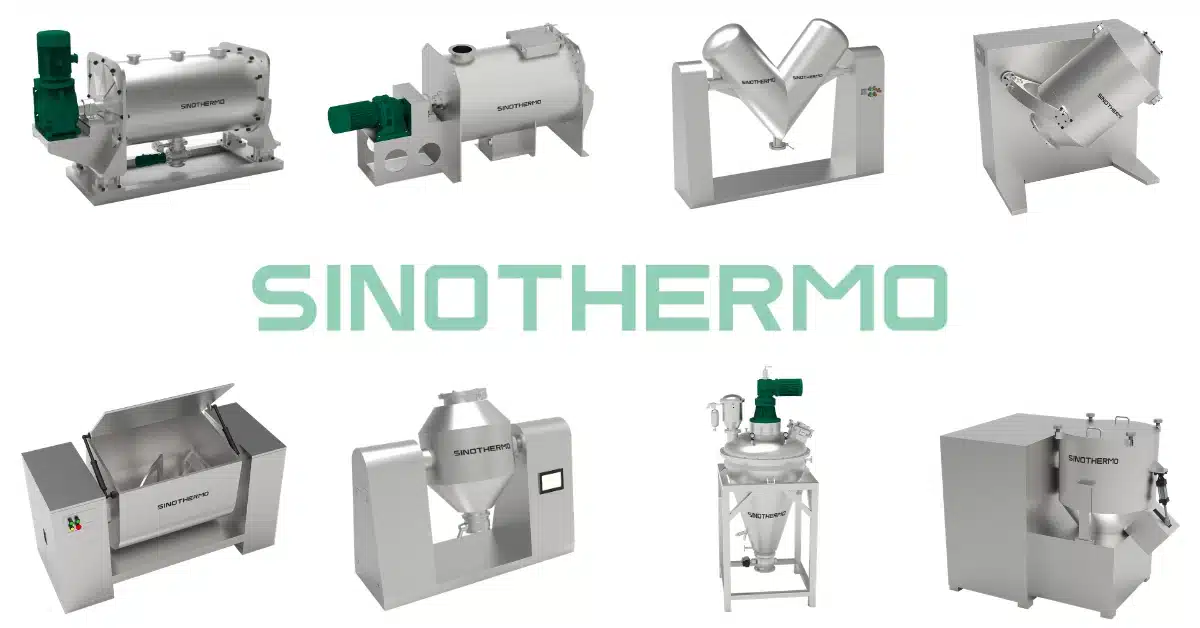
With your material state defined, match it to a mixing action. The table below maps each common industrial mixer to what it does best and links to a deep-dive article and the corresponding SINOTHERMO product page.
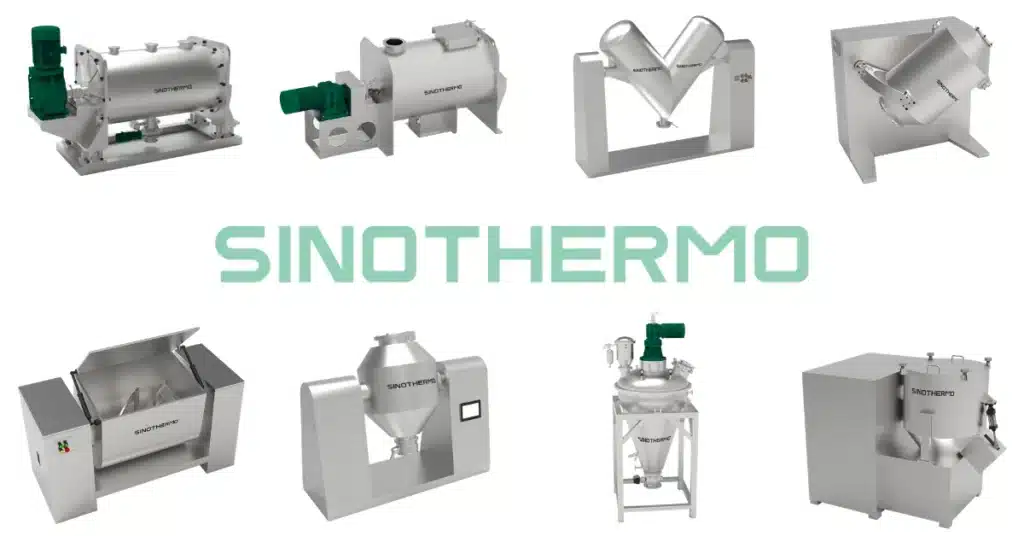
| Mixer type | Mixing action | Best for |
|---|---|---|
| Horizontal Ribbon Mixer | Double helical ribbon moves material axially + radially | Dry, free-flowing powders and granules; large batches; the workhorse blender |
| Ploughshare Mixer | Plough blades fling material into a fluidized zone; optional choppers | Fast, intense mixing; wetting/liquid addition; agglomeration; short cycles |
| Sigma Mixer | Twin Z-shaped (sigma) blades knead and shear | Thick pastes, doughs, high-viscosity masses, sealants, rubber |
| Double Cone Blender | Gentle tumbling of the whole shell | Fragile granules; free-flowing powders needing low-shear, contamination-free blending |
| V Blender | Tumbling split-and-recombine in a V-shell | Free-flowing powders; gentle, thorough dry blending; easy cleaning |
| Conical Screw Mixer | Orbiting screw lifts material up the cone wall | Gentle blending of large volumes; shear-sensitive and low-density powders |
| High Speed Mixer | High-RPM impeller for intense shear | Fast dispersion, heating by friction, pre-mix and granulation prep |
| Rotary Drum Mixer | Slow rotating drum with internal flights | Gentle blending and coating of granules, pellets and abrasive solids |
If your material is dry and free-flowing, a ribbon blender or tumbling blender (double cone blender or V blender) usually wins on cost and simplicity. If it’s fragile or cohesive, favour a low-shear tumbler or conical screw mixer. If you need fast mixing or liquid addition, the ploughshare mixer with choppers and spray bars is built for it. If it’s a thick paste or dough, only a sigma mixer kneader will do the job.
Step 3 — Size the mixer
Sizing is where good specifications are won or lost. The headline number to get right is working volume — the volume your batch actually occupies — not the geometric shell volume. Every mixer type has an ideal fill level, because it needs headroom for material to move:
- Ribbon blender: fill to 40–100% of rated volume. Ribbons work across a wide window, but below ~40% the batch may not reach the agitator.
- Tumble blenders (double cone / V): fill to only 50–60%. Tumbling needs empty space for material to cascade and recombine — overfill and you get dead cores.
- Sigma mixer: fill to 40–70% of the trough. Stiff pastes need room for the blades to fold and knead.
Work the sizing in this order:
- 1.Start from batch mass. Take your target batch weight in kg.
- 2.Convert to volume using bulk density. Working volume (L) = batch mass (kg) ÷ bulk density (kg/L). A light 0.4 kg/L powder needs 2.5× the volume of a 1.0 kg/L one for the same mass — bulk density is the number buyers most often forget.
- 3.Divide by the fill level for your chosen type to get the required rated volume. Example: a 300 kg batch at 0.5 kg/L = 600 L working volume; in a tumble blender at 55% fill that means a ~1,090 L rated machine.
- 4.Check cycle time against throughput. Multiply batch volume by batches-per-hour (mixing + charge + discharge + cleaning) to confirm the machine meets your daily tonnage. A fast ploughshare mixer may beat a larger ribbon blender on throughput because its cycle is shorter.
Size for the batch you’ll run most, not the largest you can imagine — an oversized mixer run half-empty mixes worse, not better.
Step 4 — Understand what drives cost
Once type and size are set, price is driven by a predictable set of factors. Knowing them lets you compare quotes fairly and avoid paying for options you don’t need.
- Capacity. The single biggest lever — larger working volume means more steel, bigger drives and heavier structure.
- Material of construction (MOC). Carbon steel is cheapest; SS304 suits most food and chemical duties; SS316L with a GMP / pharma finish (polished, crevice-free, validated) costs significantly more but is mandatory for pharmaceutical and hygienic work.
- Process options. Each of these adds cost: heating/cooling jackets, vacuum capability (for drying or oxygen-free mixing), high-speed choppers, liquid spray bars, and the discharge system (butterfly valve, flush-bottom, bag-dump, or pneumatic).
- Automation. A manual machine with a basic starter is cheapest; recipe control, PLC/HMI, load cells for in-mixer weighing, and full data logging add capability and cost.
The cheapest quote is rarely the cheapest machine to own. A properly specified ploughshare mixer with the right chopper and discharge can outperform two cycles of a bargain blender — always compare on cost per validated batch, not sticker price.
Step 5 — Test before you buy: prove it in a pilot lab
A specification sheet rarely settles the question. Two powders that look identical on paper can behave very differently once an agitator is turning — the same blend can homogenize cleanly in a ribbon mixer and segregate in a tumbler, or degrade in a high-shear unit that a competitor swore was fine. The reliable way to choose is to run your own material and measure what you get: blend uniformity, cycle time, particle integrity, temperature rise and discharge behavior, before committing to a production line.
This is the step most buyers skip and later regret. As a process-engineering manufacturer with 20+ years of experience, SINOTHERMO doesn’t just supply the equipment — we help you prove the choice. Bring your material to our in-house pilot laboratory, trial it on full-scale ribbon, ploughshare, sigma and tumble mixers, and select on evidence rather than assumption. Every machine we build is then engineered around your validated process, not adapted from an off-the-shelf model. That is what process engineering infrastructure means: we solve the mixing problem, not just sell a mixer.
Common mistakes to avoid
- Sizing by shell volume instead of working volume. Always size from batch mass and bulk density, then divide by the correct fill level — never buy on the geometric capacity alone.
- Ignoring bulk density. A light powder needs far more volume than its weight suggests; forgetting this is the most common cause of an undersized mixer.
- Matching by habit, not by material state. “We’ve always used a ribbon blender” is not a spec. Fragile granules, pastes and liquid additions each demand a different action.
- Under-specifying the MOC or finish. Discovering after delivery that you needed SS316L or a GMP polish is a costly retrofit — flag hygiene and validation requirements up front.
- Skipping the pilot trial. A quote can’t predict how shear, fill level and discharge interact with your specific material. Trial first, specify second.
Conclusion
Choosing an industrial mixer comes down to five ordered steps: identify your material state, match it to a mixing action, size the working volume against bulk density and fill level, understand what drives cost, and prove the choice on your own material. Get the type right and a ribbon, ploughshare, sigma or tumble blender will run for decades; get it wrong and no adjustment will rescue the process. The spec sheet narrows the field — a pilot trial confirms the winner.
Not sure which mixer fits your material? Talk to our process engineers and book a trial in our pilot lab — we’ll help you decide on data, not assumptions.
FAQ
How do I choose the right industrial mixer?
Start from your material state — dry and free-flowing, fragile or cohesive, needing fast mixing or liquid addition, or a thick paste. Match that to a mixing action: a ribbon blender or tumble blender for free-flowing powders, a ploughshare mixer for fast mixing and wetting, a sigma mixer for pastes and doughs. Then size the working volume, weigh the cost drivers, and confirm the choice with a pilot trial on your own material.
What is the difference between a ribbon blender and a ploughshare mixer?
A ribbon blender uses a double helical ribbon to move powder axially and radially — a reliable, economical workhorse for dry, free-flowing batches. A ploughshare mixer uses plough-shaped blades that fling material into a fluidized zone, giving faster, more intense mixing and easy liquid addition through spray bars and choppers. Ploughshare units suit shorter cycles and wetting; ribbon units suit simple large-volume dry blending. See our ribbon blender vs ploughshare mixer comparison for related detail.
How do I size an industrial mixer?
Convert your target batch mass to volume using bulk density (working volume in litres = batch mass in kg ÷ bulk density in kg/L), then divide by the correct fill level for the mixer type — about 40–100% for ribbon blenders, 50–60% for tumble blenders, and 40–70% for sigma mixers — to get the rated volume. Finally, check that cycle time meets your throughput target.
What is the correct fill level for a mixer?
Fill level depends on the mixing action. Ribbon blenders tolerate 40–100% of rated volume; tumbling blenders (double cone and V-blenders) should be filled only 50–60% so material can cascade and recombine; sigma mixers run at 40–70% of the trough so the blades can knead. Overfilling any tumbler creates a dead, unmixed core.
What drives the cost of an industrial mixer?
The main drivers are capacity (working volume), material of construction (carbon steel vs SS304 vs SS316L with a GMP finish), process options (heating/cooling jackets, vacuum, choppers, spray bars, discharge system), and automation level (manual vs PLC/HMI recipe control with load cells and data logging). Compare quotes on cost per validated batch, not on sticker price.

Mark Gu
Passionate about enhancing customer experiences and streamlining operations, Mark focuses on building strong relationships, fostering innovation, and leading teams to achieve exceptional service and efficiency.
Email: mark.gu@sinothermo.com
Phone: +86 18021972660